

How To Draw A Realistic Nose Step By Step
The Basics of the Nose
For some reason, when it comes to noses, people struggle. Perhaps this is because a olfactory organ is an irregular grade - information technology'due south not a simple shape like a circle and it'south not quite a triangle either. It's non as difficult to depict realistic noses as ane may think. Information technology's really rather simple. All it takes is four lines and then the rest is adding value. Don't autumn into the trap of thinking that drawing noses is difficult.
Many people have incorrectly learned how to draw a nose. When you learn something incorrectly, it is fifty-fifty harder to learn how to do it correctly. This is true of anything, not just drawing. Many of us accept been taught to draw that "L" shape or perchance the "w" shape with an extra "u" when we describe a nose.
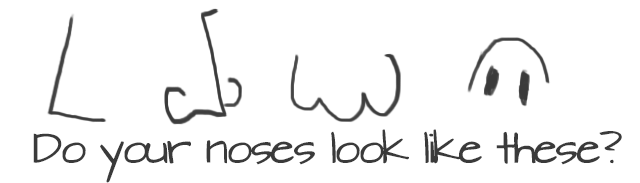
Drawing noses this way is so far from drawing them realistically. If you are going for a cartoon olfactory organ, and so that may exist a proficient direction to go. But for a realistic olfactory organ, yous must really observe your subject.
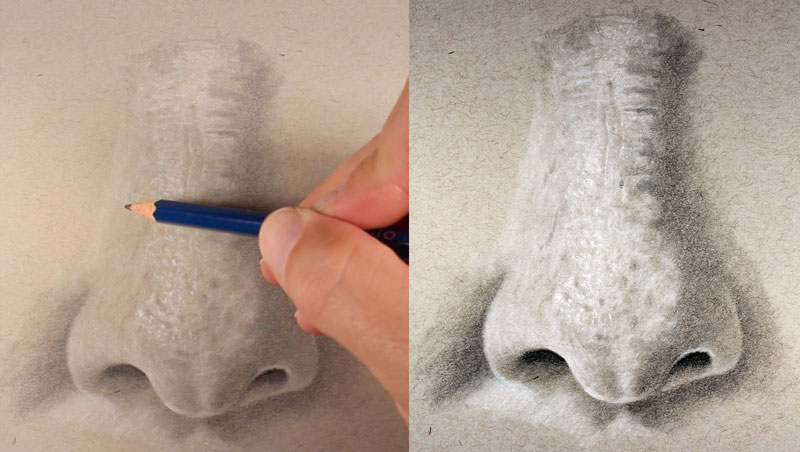
Hither's a look at the finished cartoon from the video above...
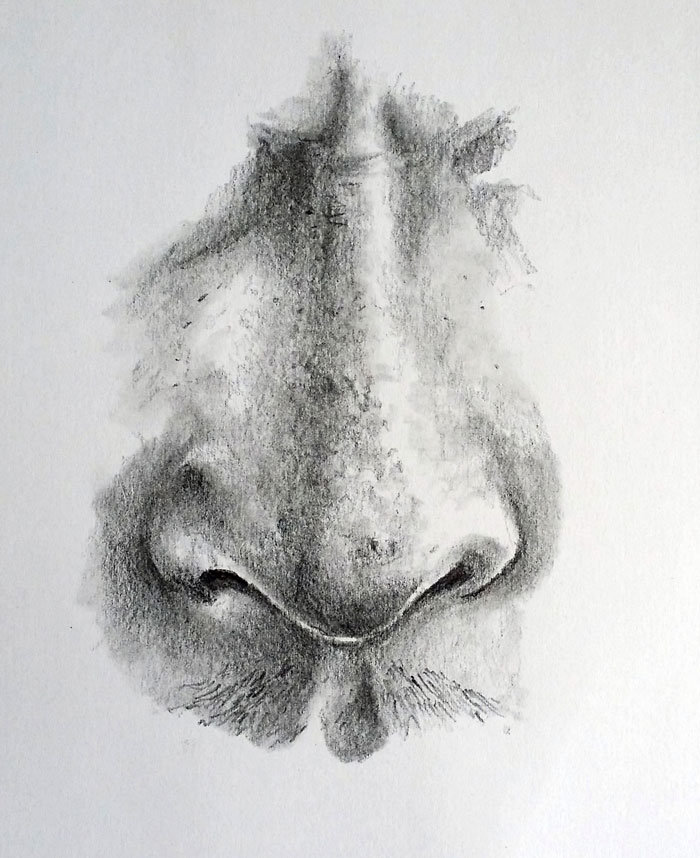
The Primal is Observation
You must closely observe your subject field when you describe anything. Drawing noses realistically involves studying the values. The values are what gives us the impression and illusion of the form. Make sure that you include a full range of value when you describe a nose.
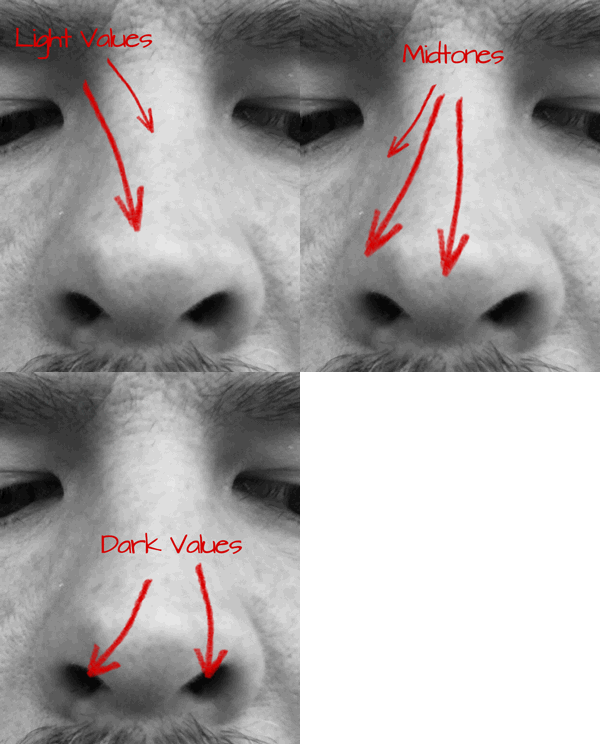 Drawing lines will help to constitute the shape of the olfactory organ, just it's the values that volition atomic number 82 to the illusion of form that you probably want in you cartoon.
Your drawing must include the darkest shades and the lightest tints and the grays in between. Proceed in mind that no two noses will be the same. Observation is really the biggest surreptitious when it comes to cartoon.
Try to pinpoint the locations on the olfactory organ where these values are located and discover the subtle changes that happen in the highlights (calorie-free values), midtones (center values), and the shadows (dark values).
Drawing a Nose from a Frontal View
Nosotros'll explore several different options for drawing a nose in this lesson and wait at a number of examples. It makes sense to look at drawing the nose from a frontal view first. This way, we can better understand the construction and what we should look for and include in our cartoon.
Before drawing any lines, we'll starting time examine the course of the nose and how we can simplify it into a system of planes.
Understanding the Planes of the Olfactory organ
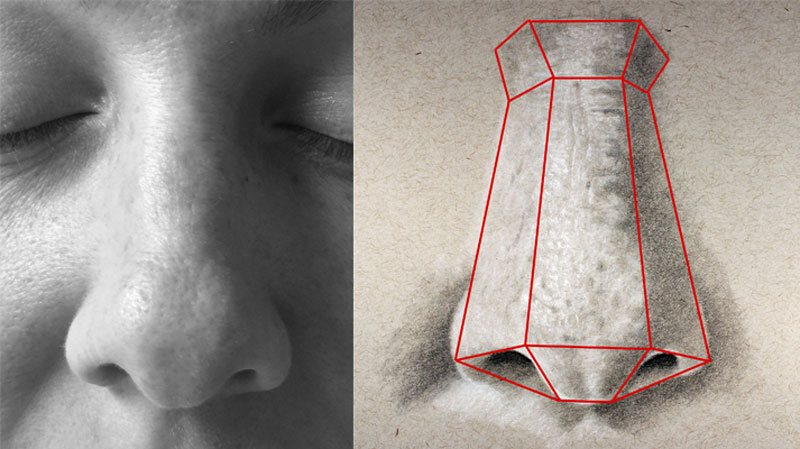
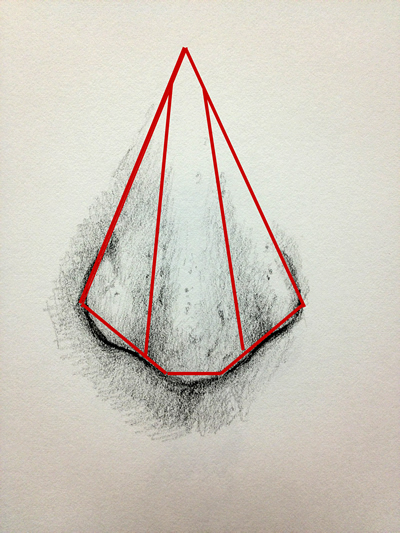
A nose tin can exist simplified into basic planes. You may call up of a chiseled form to meliorate sympathize the planes. Remove the curvature of the olfactory organ from your mind and simplify the form into rigid apartment planes.
Recognizing the planes not only helps united states to draw the form, but it also helps usa to sympathise where we should add shading. It is the shading, or value range, that ultimately leads to the illusion of a 3-Dimensional grade.
In the prototype below, yous'll come across an example of a nose from a frontal view, simplified into basic planes. As the form changes direction in space, it creates a new airplane. At that place are iii planes designated for the top, 3 for the middle, and 3 underneath.
In the showtime stages of the cartoon, yous may find information technology helpful to draw these planes get-go. This style, you lot can focus on the class before cartoon whatever of the lines for the nostrils or adding tone.
Cartoon the Perceived Lines
When virtually of us learn to draw, we start by cartoon lines. We employ lines to define the boundaries of objects and to add together details. So it's only natural to look for lines when we draw whatsoever object.
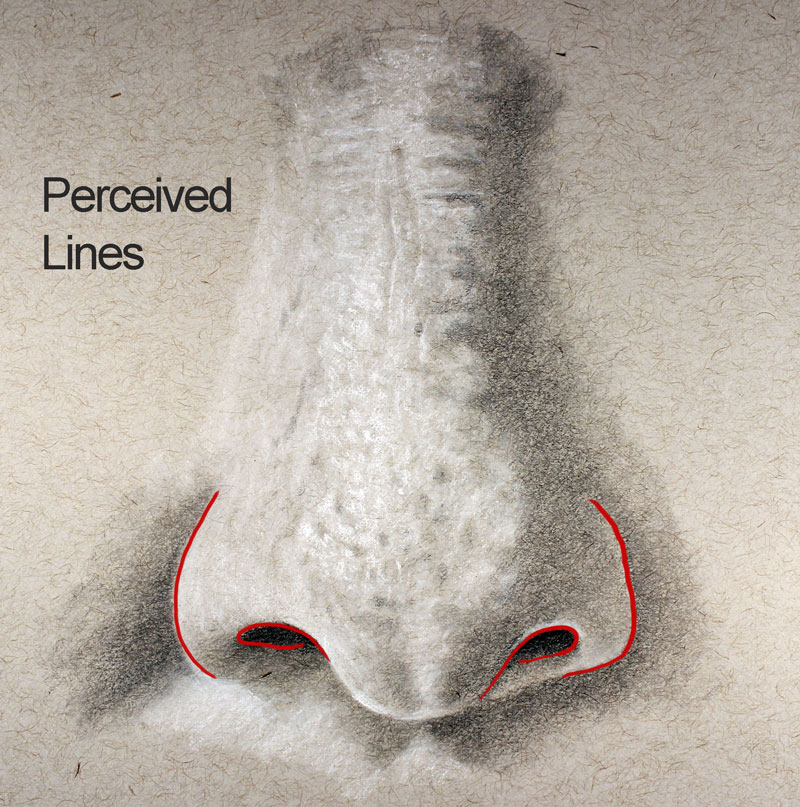
A nose, however, doesn't feature strongly defined lines. Our heed simplifies changes in value or contrast into "perceived lines". For a nose, these areas include the shapes of the nostrils and the outer edges of the nostrils. This is simply considering we notice strong contrast in value in these locations. In reality, the value changes gradually, instead of creating a defined line.
We tin can use the planes of the olfactory organ to position the perceived lines that we meet. Using the outer boundaries of the planes, we tin can mark the outer edges of the nostrils. We tin can also use the bottom planes to position the shapes of the nostrils.
Shading the Nose
Understanding the planes of the olfactory organ helps us to draw the basic structure and position the "perceived lines", but the planes as well perform another important chore. We can use these planes to determine the locations of value.
In this example, the low-cal source originates from the upper left corner. This produces lighter values on the left side of the olfactory organ, closer to the light source. This ways that the plane that faces the light source will be lighter. Darker values are found on the opposite plane on the right side of the nose.
Since our light source is also coming from above, you lot'll discover that the planes underneath the nose are also darker. There is, however, a slight highlight in areas here.
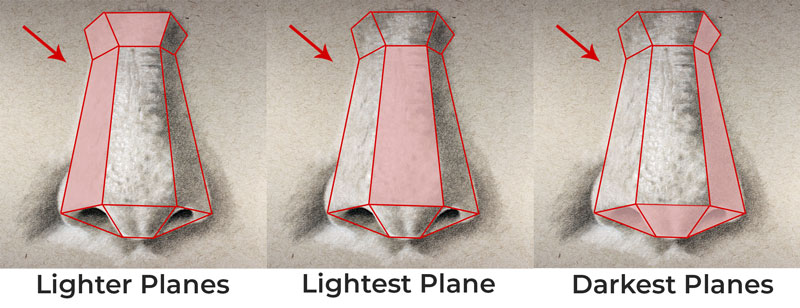
The span of the nose protrudes outward. Equally a general dominion, virtually objects that beetle receive more than light and are usually lighter in tone. They as well commonly produce a shadow underneath. In this instance, the bridge of the olfactory organ is receiving the strongest light. The values adult here should be slightly lighter than the values found on the left plane of the nose.
Now that we take a bones understanding of the locations of value and how dark or light they should be, we can begin the process of shading. Yet, the term "shading" is somewhat confusing. It suggests that we are only addressing the dark values, or shades. In reality, the process of "shading" is the procedure of developing a total range of value. This means we should consider both the tints (light values) and the shades (dark values) together.
If you lot're working on white paper, you lot may cull to leave the areas of highlight "open" or accost them with a very light application of graphite. If you are working on toned paper, every bit we come across with this cartoon, you lot tin can add the highlights with a lite drawing medium. In this instance, a white charcoal pencil is used.
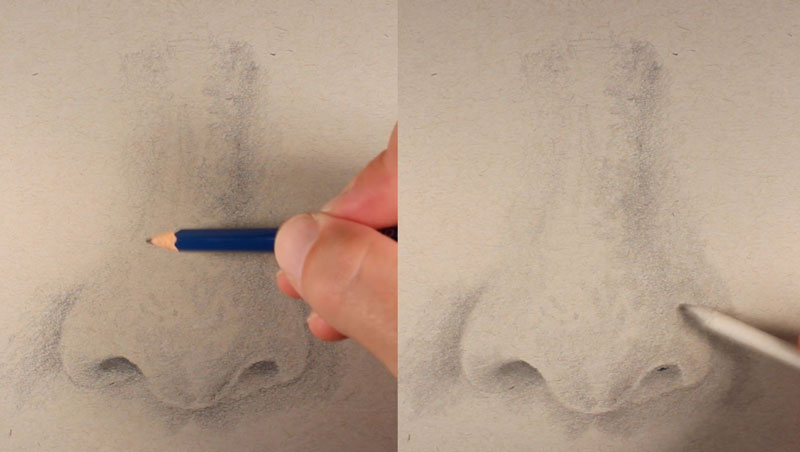
Prior to adding the highlights, we'll begin with a lite awarding of graphite using an H graphite pencil. This gives u.s.a. a starting point.
A blending stump is then applied to polish the texture and work the graphite material into the tooth of the newspaper.
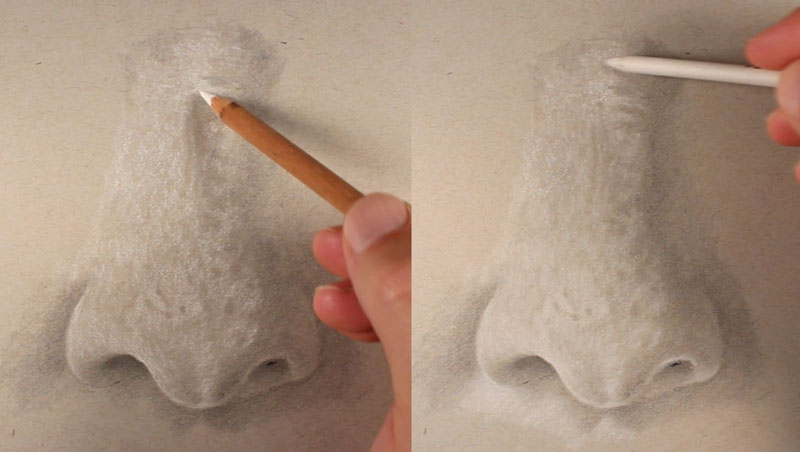
In one case the locations of darker value are established with a light awarding, we can define the highlights with a white charcoal pencil. Again, this awarding is gently blended with a blending stump.
Then it's a matter of gradually concealment the shades to increase contrast. A softer and darker, graphite pencil is used the darken the areas within the nostrils and the shadows that exist on the right side and underneath the nose.
We can also continue to add together highlights, if necessary, to extend the range of value and the dissimilarity. As applications are fabricated, they are gently blended with a blending stump. You'll detect that as the value is adult the texture of the nose is besides adult.
A more in-depth video of this lesson, along with an illustrated ebook can be constitute in the grade, "Portrait Drawing the Smart Mode".
How to Depict a Olfactory organ Footstep by Step
Here'south the process that we outlined higher up, simplified and cleaved down into a stride by stride arroyo...
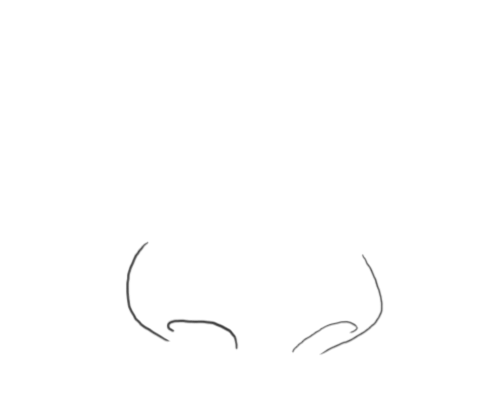
Brainstorm your drawing of a nose by drawing 4 lines. Two lines are drawn for each nostril and and so two more for each edge of the olfactory organ.
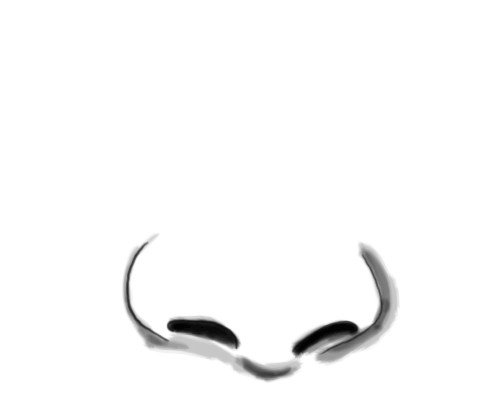
Now you can begin to add darker values where the olfactory organ is shaded. Beginning with the areas that are the darkest and slowly go darker with your pencil.
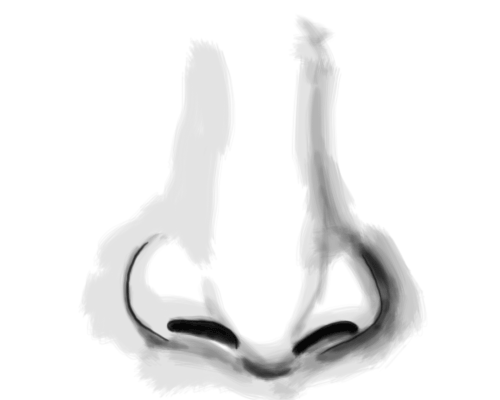
Continue with adding shading to the nose to create the illusion of a calorie-free source. Exist careful not add more lines. Instead, just concentrate on light and dark areas.
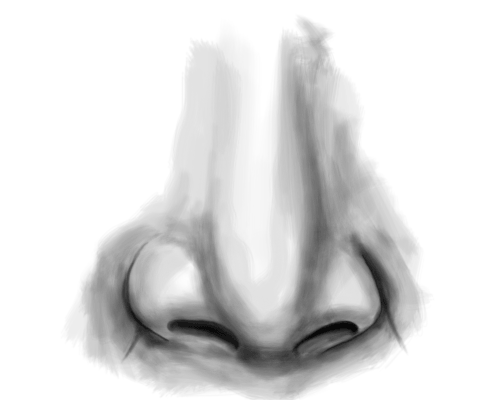
The more value that you lot add, the more your olfactory organ will await realistic. Areas of the nose that are lite volition look like they protrude, while areas that are dark will look like they go back in space.
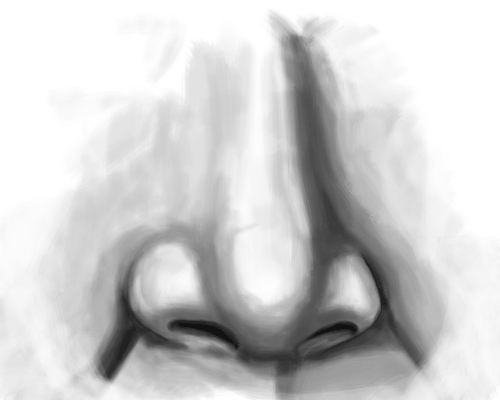
As long as you proceed looking for the dark and low-cal areas on the olfactory organ, and draw what you lot see, your nose will look realistic.
In one case you accept a basic thought of how to draw a nose from a frontal view, it'south time to wait at cartoon a nose from the side.
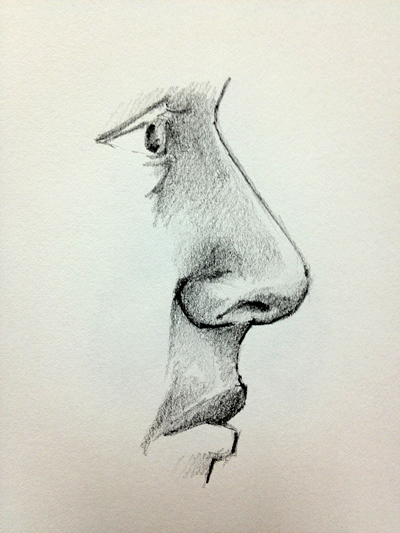
Drawing a Nose from the Side View (Profile)
There's more than than i way to draw a nose. In fact, since every nose is different, at that place are virtually unlimited means to depict a nose. Next, we'll take a look at drawing a nose from a side view. This is usually referred to every bit a profile view.
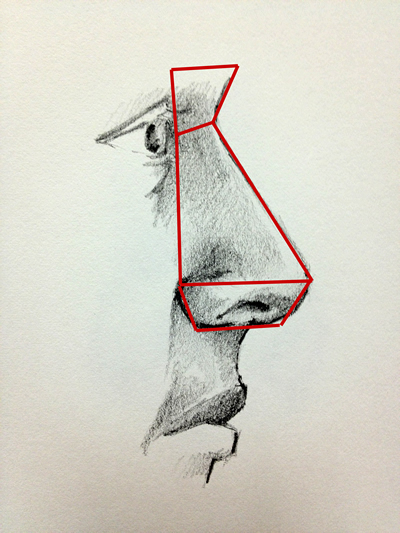
Every bit nosotros did with the frontal view, we'll first locate basic shapes. When drawing a nose from this angle, it may exist hard to identify the planes, so basic shapes will suffice.
Look for changes in spacial direction to find the nearly basic shapes. As we encounter below, the upper portion of the olfactory organ can be simplified with ii shapes. The lower portion of the olfactory organ is simplified into an organic shape that extends downward from the top 2 shapes.
We'll draw these basic shapes kickoff to ascertain the form of the nose.
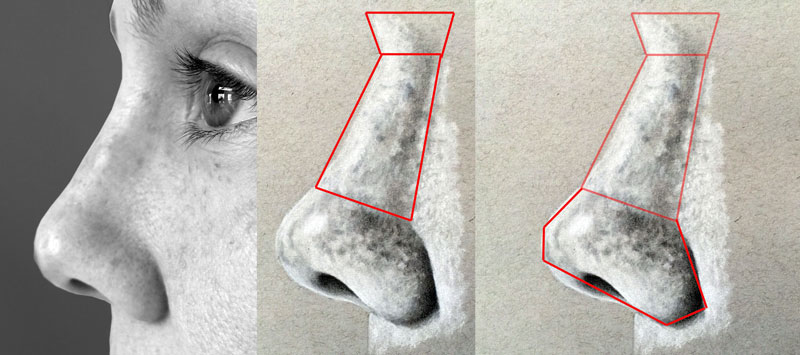
Next, we tin draw the perceived lines that we discussed earlier along with the outer contours. After these lines are in identify, we tin begin the process of developing the value and texture.
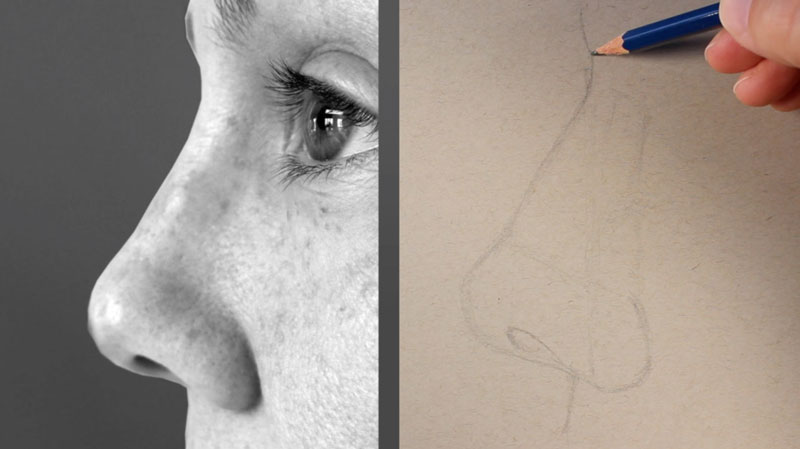
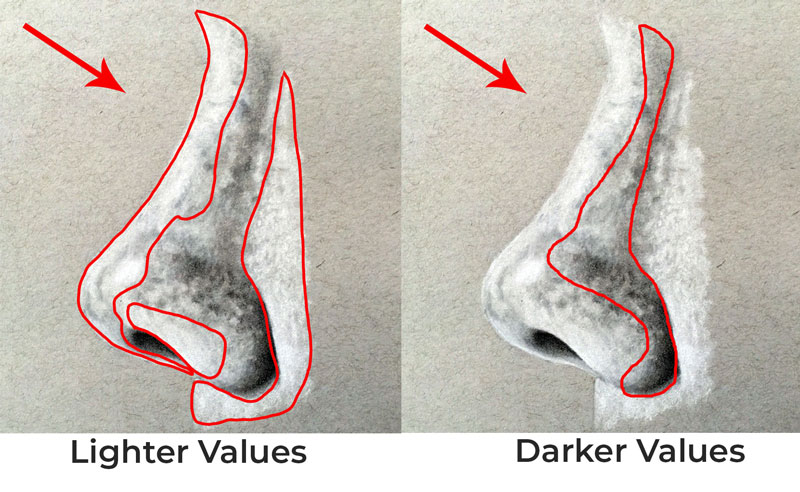
Every bit nosotros develop the value range, nosotros'll consider the light source. As nosotros see in this instance, the lite source originates from the left. This creates shapes of different tones on the nose. The bridge of the olfactory organ receives the most calorie-free. The cheeks are also receiving a fair amount of calorie-free. Curiously, the lesser of one of the nostrils is also lighter. This is the result of calorie-free reflecting back up from below, producing an expanse of reflected highlight.
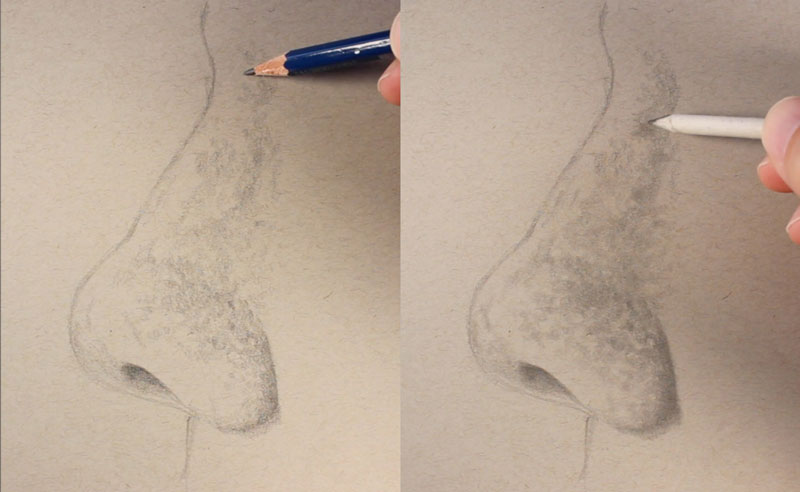
As nosotros did before, we'll start adding low-cal graphite applications to establish the shapes of the darkest value. These applications are blended with a blending stump to create a smoothen texture.
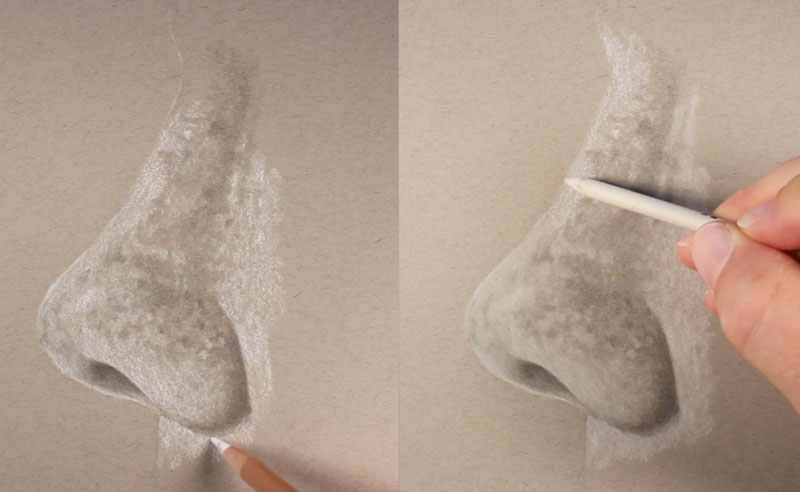
And then nosotros can add the highlights. In this example, we're again working on a toned cartoon surface. This allows u.s. to add the highlights with a white medium like white charcoal. After the initial highlights are added, we tin blend them likewise.
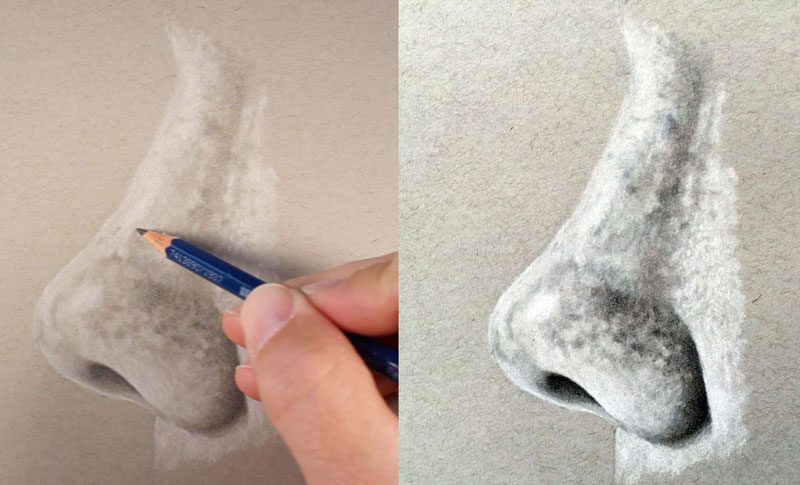
Now nosotros merely need to darken the value to create a full range and increase the contrast in the drawing. Softer graphite pencils are applied and blended to gradually "push button" the tonal range.
For more on this sit-in meet the course, "Portrait Drawing the Smart Way".
Drawing a Nose From Observation - Put It Into Practise
Now that you've got the basic concept down, it's time to take your skills to an actual subject. This might be a nose that you draw from life, or one that you describe from a photograph reference. Either way, the process of drawing will heavily depend on observation.
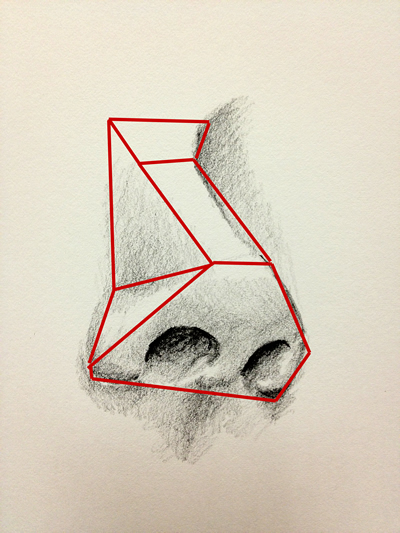
When you are observing a nose, await for the "planes" - or simple geometric shapes that stand for how the nose exists in space.
Take the following cartoon for case...
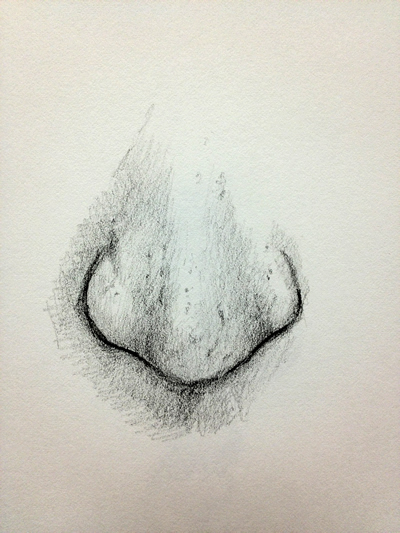
Now expect at the planes that can be hands fatigued to create the course of the nose...
Hither'due south another look at the nose from the side view.
Here is the same drawing with the planes highlighted...
Certain angles of the nose tin can present challenges...
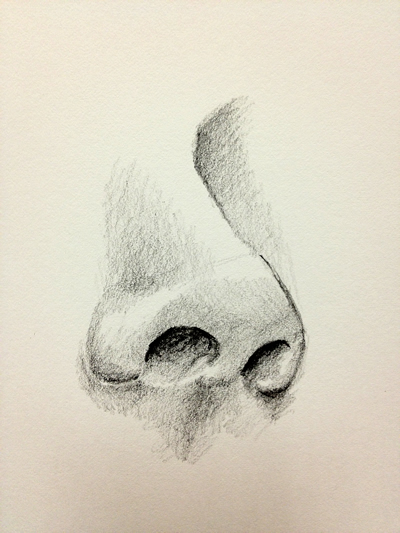
But here again, if you break the nose down into geometric planes, this angle is fabricated easier to draw...
Conclusion
Now that we've had at look at several different noses, you are well equipped to depict your own. But retrieve the steps we took...
- Find and draw the planes.
- Describe the perceived lines of the nostrils and contours.
- Develop a range of value and texture.
As e'er, take your time and be patient. With practice, you'll master the fine art of cartoon noses.

Source: https://thevirtualinstructor.com/graphitenose.html
Posted by: woodsgail1951.blogspot.com
0 Response to "How To Draw A Realistic Nose Step By Step"
Post a Comment